By Anders Lorenzen
A pencil that can become a plant? My first thought, when I was first contacted about the product, seemed like a storyline in a book I would read or a cartoon I would watch with my two-year-old daughter.
But I quickly realised this was a real thing, and the Danish-based company SproutWorld had developed an impactful and innovative product.
Another level
The B-Corp-certified company takes second-life products, reusability, sustainability and the circular economy to a whole new level.
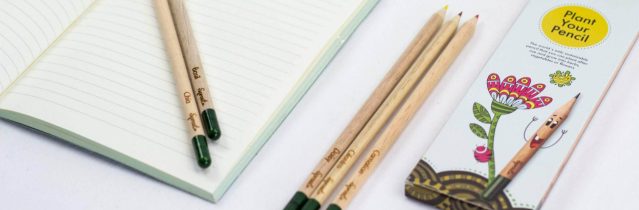
When I got my hands on the pencils, they looked like ordinary pencils, with the obvious use case as a writing and drawing tool and I liked its simplistic design, but at the end of the pencil was a green know which I worked out would be the plantable part.
A bit of context and history
Before we examine the products in further detail, let’s recall how Sproutworld started. The seed, quite literally, was planted at the Massachusetts Institute of Technology (MIT) in Cambridge, Massachusetts, US.
SproutWorld founder Michael Stausholm created the concept in 2013 after coming across the pencil on the crowdfunding website Kickstarter.
Sustainable simplicity
Subsequently, he fell in love with its simplicity and sustainable innovation. From there onwards, he envisioned a commercial potential and bought the patent and global rights to the pencil.
Since then, the company has grown steadily and has sold more than 50 million plantable pencils to date.
The tool
Purely looking at the product as a tool I love its simplicity and its lightweight.
From a design perspective, it looks as impressive as any pencil you can buy online or in a shop.
Sustainable proponents
The fact that it is sustainable, sourced from natural products, produces minimal waste and emissions is carbon neutral, and has a second life as a plant only adds to its proponents.
It is perfectly suited to taking quick notes or, more creatively, using it as a drawing tool.
The evolution of writing
Anything we do in today’s society has transferred to digital products such as smartphones, tablets and laptops – a trend even more prevalent when it comes to writing.
Back to basics
I’m a huge proponent of not completely dropping the manual skills and exploring creativity in the form of good old-fashioned writing and drawing with pen and pencil.
From experience, there’s something to be said for ditching the phone and laptop now and then, not only for the sole purpose of note-taking but also for long-form writing.
Brain stimulation
The way your brain conceptualises what you’re working on and your productivity differ significantly when using a pen and paper as opposed to writing on your phone and laptop.
It is not that one form is bad, they both offer something – but it is unwise to completely stop using one method.
The green and second life element
On the back of this, how do we make it cool to use a pencil again?
The excitement of being able to grow a plant out of your used pencil does at least not damage the use case.
How useful is it?
If one were to deeply analyse how useful the product is, we would need to look at how beneficial it is to plant the pencil, and if it would mean that the customer who planted the pencil would not otherwise have planted a plant, then that is a success story.
The potential of behavioural change
If you have 1,000 different individual use cases of this, then you have a significant impact. But perhaps it is the potential for behavioural change that is the biggest proponent of this product.
If that customer, on the back of that pencil, ends up living a greener lifestyle, you have a success story. However, it could just as easily be the other case, a one-hit wonder – was fun to try, but did not change much.
Like most things, the reality is probably somewhere in the middle.
Therefore the conclusion I draw is that the largest benefits might be on the corporate side of the business and the actions made on the back of corporate purchases. If a company buys let’s say 1,000 pencils for a specific event and on the back of that makes a business CSR action of planting these pencils around the office space or maybe even supporting a community project, then we are talking serious positive actions.
Down to the consumer
This is a decent and innovative product, and while not a fresh product, it adds to the trend of second-life products. But the positive potential of this product is all down to the actions the consumer – whether we are talking about an individual or business.
A wide variety of plantable pencil products can be viewed and purchased here.
Anders Lorenzen is the founding Editor of A greener life, a greener world.
Editorial note: This article has been updated to ensure that insights and data are up to date and to enhance its readability.
Discover more from A greener life, a greener world
Subscribe to get the latest posts sent to your email.
Categories: CSR, innovation, Reviews, sustainability
 A greener life, a greener world
1 reply »