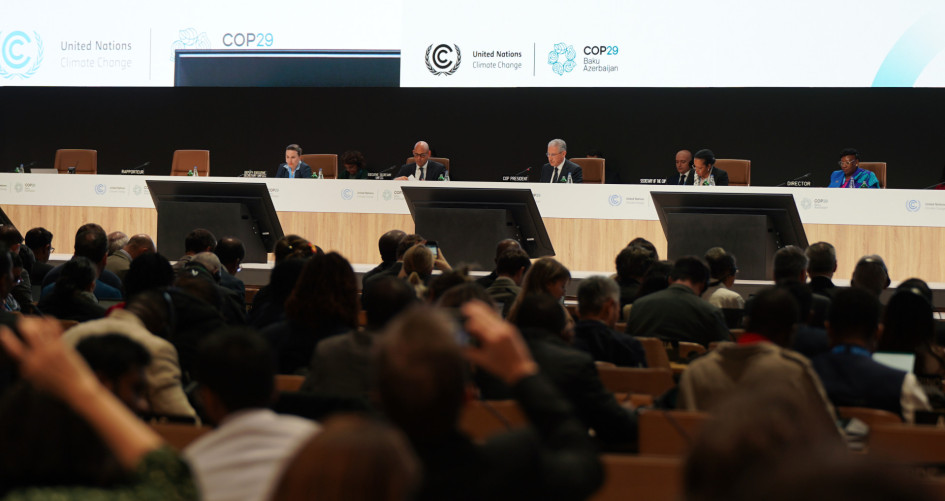
By Anders Lorenzen
Campaigners and critical stakeholders had called this year’s UN climate summit, COP29, held in oil and gas-rich Azerbaijan, the worst COP ever. Many had walked out in disgust and given up hope that a deal could be reached.
But on Saturday evening, sleep-deprived negotiators could breathe a sigh of relief as the COP29 presidency could hail a historic agreement.
The COP29 two-week climate negotiations got off to a bad start for the hosts. A leaked recording showed a vital member of the presidency being exposed for wanting to use the summit to strike fossil fuel deals. When the country’s president delivered a keynote speech, it had little to do with tackling climate change. He declared fossil fuels to be ‘a gift of god’ and used the platform the summit presented him with to attack Western democracies.
It was also revealed that a member of the Saudi Arabian negotiation team had been amending the text of a draft agreement.
Low ambition levels
It quickly became clear that the ambition levels had been even lower than at COP28, which was held in another fossil fuel economy, the United Arab Emirates (UAE).
COP29 has been labelled the finance COP. One of the key objectives is to decide how much money developed economies should annually contribute to the loss and damage fund, which compensates developing economies for climate-induced extreme weather events they have done little to cause.
COP29 has been labelled the finance COP, with one of the key objectives being to decide how much money developed economies should annually contribute to the loss and damage fund, which is to compensate developing economies for climate-induced extreme weather events they have done little to cause.
Several countries walked out, calling the talks a disgrace after a draft text had the annual contribution to the loss and damage fund at a record $250 as laughable. In the end, in the final agreement text, there had been some movement on this number to $300bn, which is a trebling of the current amount but well below the $ 1.3tn that many developing economies had called for.
The climate activist group 350.org was far from impressed with the final agreement, with its Policy Lead, Andreas Sieber, stating: “In Baku, we saw the future of our planet and the dignity of countless lives diminished to the minimum, a concession to wealthy governments determined to evade their moral and financial responsibilities. What was presented as progress was, in reality, the lowest common denominator.
With the often more pragmatic World Wide Fund for Nature (WWF) acknowledging that some progress was made. Reuben Manokara, WWF Carbon Finance and Markets Taskforce, Global Lead said: “While the final text is not perfect, it provides a degree of clarity that has long been absent from international efforts to coordinate emissions trading and carbon crediting.”
Simon Stiell, the Executive Secretary of the United Nations Conventions on Climate Change (UNFCCC) said: “No country got everything they wanted, and we leave Baku with a mountain of work still to do.”
During COP29, a series of influential voices, including the former head of UNFCCC, Christiana Figueres, and one of the key architects of the Paris Agreement, called for the COP process to be radically reformed.
Discover more from A greener life, a greener world
Subscribe to get the latest posts sent to your email.
Categories: climate change, COP29, finance, policy
 A greener life, a greener world