By Jeremy Williams
When Trump won a second term in November, a whole lot of ink was spilt over why. Much of it focused on things the Democrats had got wrong or why Kamala Harris wasn’t quite good enough. I find the simplest and most obvious conclusion more chilling: a majority of Americans want Trump as president. They know what they’re going to get, paranoia, hate, and open talk of revenge and repression. To this, voters essentially said yes, or at least agreed to go along with it.
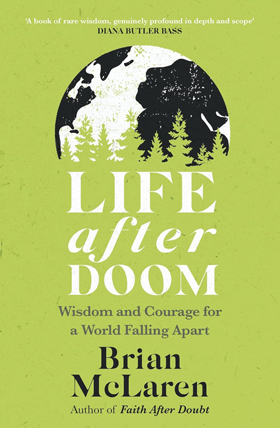
Life After Doom: Wisdom and Courage for a World Falling ApartThat’s profoundly depressing in itself, even without the setbacks to climate change, justice and peace. There’s really no silver lining, and it’s worth reflecting on how we respond in such moments. Our instincts are often to look for reasons for hope, why it might not be so bad. That can be a false reassurance, and it takes a certain kind of courage to push back at this instinct, as Brian McLaren does in his book Life After Doom: Wisdom and Courage for a World Falling Apart.
As a word, doom has its origins in Old English legal structures. Doom, or dom, was the king’s judgement. Where your authority prevailed was your kingdom or your domain. With its portentous double o’s similarly removed, it lives on in the word condemned. Doom is a negative outcome that cannot be escaped, and it can apply to individuals, communities, systems or civilizations. It doesn’t have to mean the end of the world, which is why McLaren’s title is important – there is life after doom. How do you live well when you know things are going to get worse? How do you protect your mental health and keep cynicism at bay?
These are useful questions in a turbulent time when the feeling that things are not going to end well occurs with alarming frequency. They’re not questions that many of us want to ask, and McLaren states early on that the book is not for everyone. It doesn’t hold back from difficult facts and the possibility of some very negative outcomes indeed – including civilizational collapse. McLaren suggests that it is already too late to avert climate and ecological disasters. The fossil-fuelled economy is on borrowed time. At this point, we don’t know what else might be lost in the turmoil as people turn to extreme politics, scapegoating and conspiracy. In the face of all this, McLaren detects a mounting sense of frustration and even despair.
McLaren responds to this as a long-standing activist for the environment and social justice. He’s also a retired pastor, someone who has spent a lifetime steering people through some of their darkest moments. There’s an unusual kindness and care to his writing that acknowledges how readers might react and make space for their emotions. I listened to Life After Doom as an audiobook, and this comes through very well in the tone of McLaren’s narration.
The book confronts the worst in the early chapters. We have to confront reality, however uncomfortable. Then, the book moves on to how we live with what we find. Don’t deal with doom alone. Find community. “Mind your mind”, he urges us. We tend to see what we look for, so remember to notice beauty when you see it. In every situation where people are behaving selfishly, there are always those who are “living magnificently”. Should we care to join them, we can’t make it about success or failure, but the allegiance of the heart. Do we choose the side of selfishness and cruelty or of compassion and kindness?
McLaren is best known for his books on faith, though he isn’t writing specifically for a Christian audience here. Indeed, some might find it uncomfortable, as there are chapters on how bad theology has held back climate action and led American evangelicals into the arms of Trump. But McLaren draws on Christian traditions in his conclusions, along with a wide range of philosophy, poetry, and indigenous wisdom. If you want a sense of it, have a look at this sample chapter online, which offers a list of things that matter as a way of keeping perspective. “What you think matters and how you love matters more,” for example, setting a pattern that repeats throughout the list. “Your arguments matter, and your agreements matter even more.”
I don’t recommend Life After Doom as Christmas reading. Read something more fun over the holidays. Personally, I feel much more positive about the future than McLaren does. But you probably already know if you need this book or not. If you feel an “un-peaceful, uneasy, unwanted feeling” about the future, that things are spirally out of control and “not enough of us seem to care enough to change deeply enough or quickly enough to save ourselves,” then this is a wise and compassionate book that you might want to spend some time with in the new year.
First published in The Earthbound Report.
Discover more from A greener life, a greener world
Subscribe to get the latest posts sent to your email.
Categories: book review, climate change
 A greener life, a greener world
3 replies »