By Anna Bjerde
What will it take to bring electricity to 300 million people in Africa who currently live without it? This is the goal we at the World Bank have set for Mission 300 – to halve the number of people on the continent without reliable electricity by 2030.
But setting a goal is just the spark. We need a full-blown power surge of bold reforms, investments and an enabling environment for sustainable, scalable and affordable energy solutions in order to connect 300 million people to electricity in Sub-Saharan Africa by 2030.
This isn’t just an ambitious goal; it’s also one of the greatest opportunities of our time. Powering Africa is key to raising living standards, creating jobs for the millions of youths entering the job market each year, ensuring essential services, empowering women, driving digitalisation and propelling growth.
And it’s no wonder that last week at the World Economic Forum’s 2025 Annual Meeting in Davos, Africa stood out as the new frontier of growth. But with 2030 fast approaching and amid the continent’s rapid population growth, we must shift from discussion to decisive action and ignite a movement.
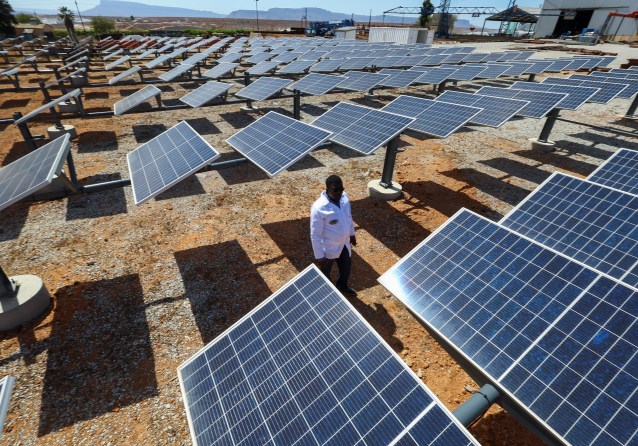
Renewables can close Africa’s energy access gap
Closing the energy access gap is within reach. With the cost of renewable energy falling over the past decade, we are closer than ever. And with Africa in the driver’s seat, this will indeed be possible.
But the scale of the challenge requires global collaboration. And that’s exactly the purpose of Mission 300, a new partnership involving governments, the private sector, development banks and philanthropies – with each stakeholder playing their part to achieve a common goal.
What is needed to make this happen?
First, bold policy reforms to break the cycle of reliance on public subsidies simply to keep the lights on for existing customers. Governments need to advance reforms to make the energy sector more efficient and attractive to private investors.
Fundamental to this is transparent and competitive bids for new generation capacity, tariff and subsidy reforms that allow commercial operation while protecting the most vulnerable with affordable connections and leveraging regional integration for trading power. Governments will also play a significant role in scaling up off-grid renewable energy for remote areas.
Second, matching ambition with funding. Donors and multilateral development banks must mobilize more concessional financing for both on-grid and off-grid electrification and mitigate risks.
To achieve Mission 300, we estimate that we will need around $30 billion in public funding and at least $10 billion in private investment. The World Bank Group, for its part, plans to increase its annual average financing from $3 billion to more than $5 billion per year for energy in Sub-Saharan Africa, in large part possible due to the recent record replenishment of the International Development Association (IDA).
Third, capacity building. Philanthropies can help derisk projects and build the necessary capacity for their long-term success. The Rockefeller Foundation, the Global Energy Alliance for People and Planet, and Sustainable Energy for All have announced a technical assistance facility to speed up Mission 300’s work.
Efforts to support Africa’s energy expansion
Most importantly, the Mission 300 African Energy Summit hosted by the Government of Tanzania – a country which has expanded its energy grid to reach nearly 100% of villages – with the African Development Bank and the World Bank Group will drive commitments to support these regional electrification efforts.
Across Sub-Saharan Africa, this movement has already begun. For example, Sierra Leone, Chad, Togo and Liberia recently joined forces to launch Africa’s first multi-country competitive grid-connected solar power tender, cutting costs by more than 70% and boosting generation capacity by more than 25%.
Other countries have already achieved impressive results. Take Rwanda, which has increased its electricity access to 75% from 6% in 2009, one of the fastest electrification expansions in the world.
Or Cameroon, where World Bank Group guarantees and financial investment leveraged over $1 billion from the private sector, leading to the completion of the 420 MW Nachtigal hydroelectric power plant last year, increasing the country’s clean, affordable energy capacity by 30%.
But much more is needed.
Mission 300 is a call to action. The clock is ticking, and we have a once-in-a-generation opportunity to ignite meaningful change and a more sustainable future.
This will not be easy, or it would have been done already, but together, we can speed up and power up Africa and unlock a brighter future for all.
Anna Bjerde is the Managing Director, Operations at the World Bank.
First published at The World Economic Forum.
Discover more from A greener life, a greener world
Subscribe to get the latest posts sent to your email.
 A greener life, a greener world
2 replies »