By Anders Lorenzen
Data released by BloombergNEF (BNEF), the clean energy analysts body owned by Bloomberg, have shown that despite the uncertainty, on a global level, the cost of clean energy technologies continues to decline.
The cost of clean energy technologies such as wind, solar, and battery technologies BNEF expects to decline further in 2025, in a boost to the viability of the sector.
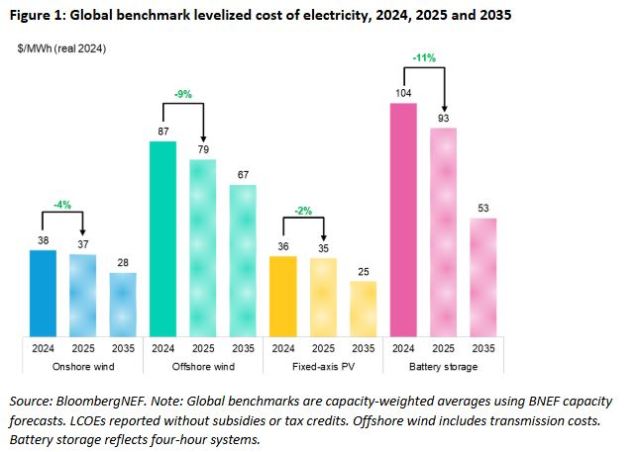
The organisation’s annual report, Levelized Cost of Electricity, released this week, states that wind and solar farms are already undercutting new coal and gas plants on production costs in almost every global market. Despite trade-war rhetorics by the US and EU on China’s clean energy products, the country is the world’s largest clean energy market, BNEF expects that the levelized cost of electricity produced by clean energy sources could fall by between 22-49% by 2035.
The report indicates that the global benchmark cost for battery storage projects fell by a third in 2024 to $104 per megawatt-hour (MWh). Global costs fell by 21% last year for a typical fixed-axis solar farm. Solar modules were sold either below or at the cost of production, and the analysts at BNEF do not think there are any signs that the overcapacity in the solar supply chain will ease in 2025. Batteries are also set to reach a new milestone in 2025, for the first time reaching the milestone of $100/MWh watershed – in a massive boost for the energy storage sector. The global benchmarks for wind and solar generation are also set to fall this year at 4% and 2%, respectively.
The report’s lead author, Amar Vasdev, said about these milestones: “New solar plants, even without subsidies, are within touching distance of new US gas plants. This is remarkable because US gas prices are only a quarter of prevailing gas prices in Europe and Asia. It really raises the bar on what is possible even in the current market.” He added, “This opens up the likelihood that solar will become even more compelling in the coming years, especially if the US starts exporting liquified natural gas and exposes its protected gas market to global price competition.”
Driven by China
China was the main driver in the declining costs last year; according to the analysis, the country’s abundance of clean-tech manufacturing capacity significantly impacted project economics both inside and outside of China. It was found that China, on average, can produce a MWh of electricity from significant power-generating technologies at 11-64% cheaper than other markets.
The report’s authors cite onshore wind turbines as an example where they cut 24% less than the global benchmark of $38 per MWh. However, as wind turbine prices have decreased in China, they have increased elsewhere since 2020. Its BNEF turbine price index shows that component prices are due to fall again in 2025, though manufacturers are keeping prices high to improve the margins.
Room for further gains
Despite the decreasing price costs and the one predicted in the next decade, BNEF believes there’s still room for further technological and economic gains. Looking ahead in the next decade up until 2035, the analysts predict onshore wind will fall by 26%, offshore wind by 22%, 31% for fixed-axis solar, with the biggest gains to be expected in battery storage at 50%.
The head of Energy Economics at BNEF, Matthias Kimmel, is buoyant and optimistic about the future of the clean energy sector and even governments, no matter what they do, can reverse the trend, “China is exporting green energy tech so cheaply that the rest of the world is thinking about erecting barriers to protect their industries.”. He further outlined his optimism, “But the overall trend in cost reductions is so strong that nobody, not even President Trump, will be able to halt it.”
The Levelized Cost of Electricity has been published for sixteen years and covers 29 technologies in over 50 countries.
Discover more from A greener life, a greener world
Subscribe to get the latest posts sent to your email.
Categories: economics, Energy, innovation
 A greener life, a greener world
4 replies »