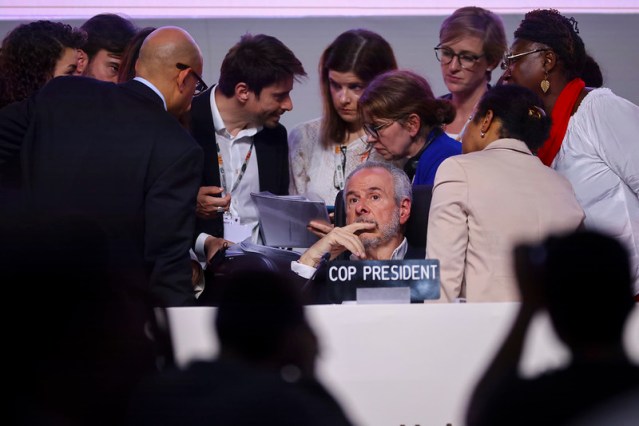
Nearly 24 hours after the COP30 negotiations had been scheduled to complete, on Saturday afternoon, an exhausted and embattled COP30 President Andre Correa do Lago declared the Global Mutirao, the name given to the agreement, adopted.
Raised more questions than answers
But it is an agreement that has come with several scars, and critical questions have been directed towards the Brazilian presidency, and many, both inside as well as outside the conference, have asked whether Global Mutirao have actually made progress or merely reiterated what had already been agreed at previous COPs.
This was indeed the argument posed by Colombia, one of the largest criticisms against what has been adopted, as well as how Brazil has conducted the negotiations.
While the Global Mutirao is just one agreed document amongst hundreds adopted at COP30, the overall conclusion by the majority of the 194 countries taking part is one of overall disappointment around the lack of ambition and progress.
Ambition not fossil fuels phased out
Many would have been buoyed by the start, with the first draft text of the agreement including language referencing a roadmap to transitioning away from fossil fuels.
Observers might have seen this to be a natural first move, after the COP28 agreement had stated the necessity to transition away from fossil fuels as after all the burning of fossil fuels is the main overriding cause of escalating climate change.
Fossil fuel nations blocking progress
However, what was to come was a 180-degree U-turn by the Brazilian presidency, with any reference to fossil fuels removed in the second draft. This was done after heavy lobbying by the fossil fuel giant and a frequent blocker of climate progress, Saudi Arabia.
A huge number of countries and the block, the European Union (EU), said this was an agreement that was completely unacceptable and not one that could be accepted.
On Saturday morning, Correa do Lago announced that any fossil fuel language would not be present in the text, but that a roadmap to transition away from fossil fuels would be handled outside the agreement, and he believed countries would nevertheless come together to adopt the agreement.
Progress on climate finance
When the Danish minister for Climate, Energy and Utilities, Lars Aagaard, delivered the EU’s response, due to Denmark handling the EU presidency at the moment, he emphasised a strong level of disappointment with the deal, but said the EU would not stand in the way and would continue to strive towards more ambition and progress.
Elsewhere, the pledge to triple climate finance was warmly welcomed, but again significant disappointment that this would not happen before 2035.
Simon Stiell: We are still in the climate fight
However, key UN people as well as national governments were keen to show a defiant face and one that showed progress was indeed made, led by UN’s climate chief Simon Stiel,l who said, “COP30 showed that climate cooperation is alive and kicking, keeping humanity in the fight for a livable planet, with a firm resolve to keep 1.5C °C within reach.
I’m not saying we’re winning the climate fight. But we are undeniably still in it, and we are fighting back.”
The diplomatic tone was echoed by the UK’s energy and climate change secretary, Ed Miliband, who said that the agreement was “an important step forward,” and said he had hoped for a high level of ambition before adding, “These are difficult, strenuous, tiring, frustrating negotiations.”
But the UN Secretary-General, Antonio Guterres, offered a mixed assessment: “COP30 showed that nations can still come together to confront the defining challenges no country can solve alone, but I cannot pretend that it has delivered everything that is needed. The gap between where we are and what science demands remains dangerously wide.”
Some of the strongest criticisms came from Panama, whose negotiator, Juan Carlos Monterrey Gomez, stated: “A climate decision that cannot even say ‘fossil fuels’ is not neutrality, it is complicity. And what is happening here transcends incompetence.”
We will have more reactions, analysis and opinions from COP30 in the coming days and weeks.
Anders Lorenzen is the founding Editor of A greener life, a greener world.
Discover more from A greener life, a greener world
Subscribe to get the latest posts sent to your email.
Categories: climate change, COP30
 A greener life, a greener world
4 replies »