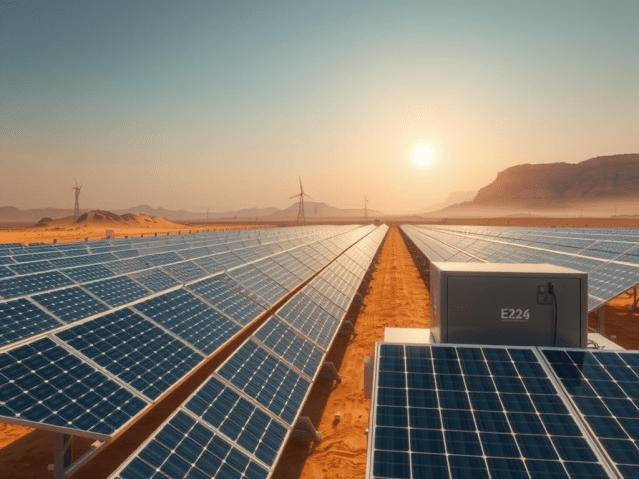
Egypt has opened 2026 with $1.8bn in clean energy deals.
Despite 2026 being less than two weeks old, there has not been a shortage of globally significant developments.
This is also the case in the North African and Middle Eastern country Egypt, which has announced a series of significant renewable energy deals.
These may be overshadowed by geopolitics, but they signal sustained momentum in renewable deployment.
Largest project on the African continent
In a deal with the Norwegian renewable energy company, Scatec, integrated solar and Battery Energy Storage Systems (BESS) projects in Egypt’s Minya region are expected to yield 1.7 gigawatts (GW) of new installed solar capacity.
Scatec will also install two standalone BESS projects.
This deal included a power purchase agreement (PPA) that covers 1.95 GW and 3.9 gigawatt hours GWh of storage.
According to Scatec, this is the biggest project of its kind on the African continent and represents the largest investment the company has ever made since it was founded in 2007.
Round-the-clock renewable energy
The CEO of Scatec, Terje Pilskog, said, “Signing this groundbreaking PPA further cements our leading position and commitment to delivering reliable, renewable energy at a large scale in Africa. By integrating advanced solar and battery technologies, we are providing Egypt with sustainable, around-the-clock power and grid stabilising services, supporting both the country’s energy transition and the region’s long-term economic development.”
In the geopolitically tense region, the Suez Canal Economic Zone, a battery manufacturing facility will be constructed by China’s Sungrow.
An uphill battle
Egypt hopes for these contracts to contribute to and aid their targets of having a 42% renewable energy share in their electricity sector by 2030.
Egypt currently has around 8.9 GW of installed renewable capacity, including hydropower, which is sometimes treated separately in international comparisons.
Egypt’s installed renewable energy capacity (2025)
- Hydropower – 2.8 GW
- Wind – 3.0 GW
- Solar PV and small biomass – 2.8 GW
Even though several new projects are under construction, the country faces an uphill battle to meet its 2030 targets.
It is estimated that Egypt’s renewable energy capacity will have doubled to 16-18 GW at the end of 2027. For the country to reach its 2030 target of 25 GW, it would need to add another 3-4 GW per year through the second half of the decade.
Egypt, which hosted the UN climate summit, COP27 in 2022, has since then focused on accelerating its transition towards renewable energy.
Signs are that its wider clean energy sector is maturing beyond generation capacity to include grid expansion and infrastructure — crucial, interlinked components of a renewable energy system.
By integrating these into its own strategy, Egypt would be hoping it would make its increasingly renewable energy-reliant grid more resilient, independent and efficient.
Through grid expansion, the intermittent sources of wind and solar power can be more efficiently transported via long high-voltage lines through the country’s complex geography.
Renewable energy generated in the desert can be transported to urban population centres where it is needed most.
To accelerate clean energy, Egypt has significantly increased the funds it allocated to it in the 2025/26 budget.
To achieve this, PPAs have become much more commonplace as they are used to bring in the private sector as well as build-own-operate (BOO) models, with several PPAs already signed.
Renewable energy and Egypt’s hydrogen strategy
Another complement to the country’s clean energy strategy is the National Low-Carbon Hydrogen Strategy, which the country established in 2024, with the aim for Egypt to claim a market share of 5-8% of the global hydrogen trade by 2040, which has the potential of attracting up to $60 billion in investment.
To attract hydrogen investments, the government has announced new tax breaks to encourage green hydrogen investments.
Renewable energy is essential to Egypt’s hydrogen strategy as it will feed the energy-intensive electrolysis. Egypt is setting up international partnerships and interconnections with neighbouring countries and allies such as Jordan, Libya, and Sudan, as well as European countries, with a longer-term ambition to export surplus renewable energy production.
Anders Lorenzen is the founding Editor of A greener life, a greener world.
Discover more from A greener life, a greener world
Subscribe to get the latest posts sent to your email.
 A greener life, a greener world
1 reply »