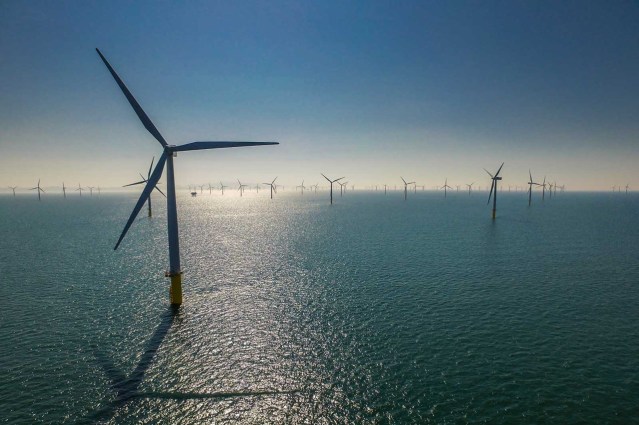
The UK government last year approved what will be the world’s largest offshore wind farm, estimated to power six million UK households, and this week the government secured the financing contract for the project in the Contracts for Difference (CfD) AR7 auction, as well as additional offshore wind projects in UK waters.
The government department, the Department for Energy Security and Net Zero (DESNZ), said that for three offshore wind farms, a record-breaking strike price of £90.91 per megawatt hour (MWh) had been struck.
DESNZ contrasted this with the current MWh price for new gas capacity of £147 MWh, adding 40% on top of energy bills compared to offshore wind.
In addition to the Berwick Bank, the other projects, the government secured the strike price for the Dogger Bank South Norfolk Vanguard offshore wind projects.
The four-gigawatt (GW) Berwick Bank offshore wind farm to be constructed off the coast of Scotland is the first offshore wind project to be built in the country since 2022.
It is to be developed by SSE renewables and the project’s financing was announced in conjunction with what the UK government called a record-breaking offshore wind auction, including a total of 8.4 GW worth of offshore wind projects in the UK, equivalent to powering 12 million UK households.
The project
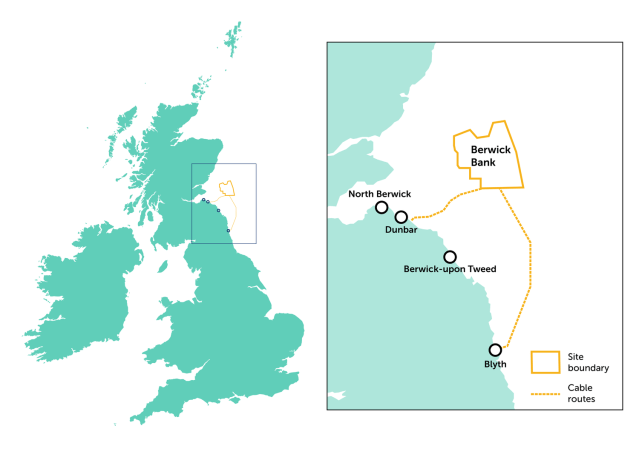
Berwick Bank is to be constructed about 38 km off Scotland’s east coast in the Outer Firth of Forth and Firth of Tay.
Construction of Berwick Bank is slated to start in 2026, with the first electricity generated and grid-connected as soon as 2027.
It is to have at least two grid connections, with one in Branxton, East Lothian, and another in Cambois, Northumberland, already approved.
SSE can now begin the construction of not only the largest offshore wind farm in the UK, but also in the world. Its Chief Executive said Martin Pibworth:
“Berwick Bank will deliver essential new low-carbon power for the UK at a competitive price for consumers. This milestone enables us to advance the project towards a final investment decision and reinforces our commitment at SSE to delivering sustainable growth and long-term value for society, for consumers and for our shareholders.”
Wider offshore wind strategy
In addition to Berwick Bank, seven other large offshore wind projects were contracted.
Contracts for Difference AR7 auction
- Berwick Bank (Phase B) – Scotland: 1.38 GW
- Dogger Bank South East – England: 1.5 GW
- Dogger Bank South West – England: 1.5 GW
- Norfolk Vanguard West – England: 1.545 GW
- Awel Y Môr – Wales: 775 MW
- Erebus Floating Wind – Wales: 100 MW
- Pentland Floating Offshore Wind Farm: 92.5 MW
- Total: 8.4375 GW
Note: These figures indicate what has been awarded in CfD AR7, which may not necessarily be the size of the project.
Displaying the latest offshore wind technology
While who will supply the turbines is yet to be announced, we can expect the latest wave of offshore wind technology and design to be on display.
There will be a maximum of 307 turbines erected, but this will depend on what offshore wind turbine model is chosen.
It is likely to be models ranging between 15 megawatts and 24 MW turbines, and the contract is likely to be awarded to either Denmark’s Vestas or Spanish-based Siemens Gamesa.
Vestas’ flagship 15 MW turbine or Siemens Gamesa 14 MW are the main contenders as SSE is unlikely to opt for a Chinese manufacturer who currently leads on developing + 15 MW turbines. However, Siemens-Gamesa are currently testing its 20 – 21 MW prototype turbine.
A boost to offshore wind
As offshore wind has faced several turbulent years due to the cost of energy, increased supply chain costs and the US government’s war on wind power, this signals a welcome boost for the sector, which will have global ramifications.
The government says that overall, it unlocks £22 billion in private investments, and these projects support around 7,000 jobs in the UK.
Commenting on the announcement, the UK Energy Secretary, Ed Miliband, said: “This is a historic win for those who want Britain to stand on our own two feet, controlling our own energy rather than depending on markets controlled by petrostates and dictators.
It is a monumental step towards clean power by 2030, and the price secured in this auction is 40% lower than the alternative cost of building and operating a new gas plant.”
A blow to marine wildlife
However, not everyone was delighted; the conservation charity RSPB reacted with disappointment. Anne McCall, Director of RSPB Scotland, stated:
“The Berwick Bank offshore wind farm is a crushing blow for marine wildlife in Scotland and beyond. When 62% of seabird species are in decline across the UK, it is an absolute disgrace that public money will be used to support what is predicted to be one of the world’s most damaging windfarms for birds. Efforts to tackle climate change must be delivered with nature in mind, not at its expense. A development that will kill tens of thousands of seabirds over its lifetime and push species like Kittiwakes and Puffins closer to extinction in Scotland is unsupportable on every level. What’s more, measures needed to try and compensate for the impact of Berwick Bank would need to be so great that this one windfarm could effectively block the progress of other, less harmful projects.”
A missed opportunity
Gillian Martin, the Energy Secretary for the Scottish National Party (SNP), Scotland’s devolved governing party, while broadly welcomed the project, called it a missed opportunity, “We have repeatedly warned that a limited AR7 budget and unfair transmission charges would put Scottish projects at a competitive disadvantage, despite holding more than a third of the total UK offshore wind pipeline. These results clearly demonstrate the impact of the UK government’s decision not to address the unfair and disproportionate transmission charges to ensure level a level playing field for Scottish projects. This must be fundamentally changed ahead of Allocation Round 8 (AR8).”
Anders Lorenzen is the founding Editor of A greener life, a greener world.
Discover more from A greener life, a greener world
Subscribe to get the latest posts sent to your email.
Categories: Analysis, Energy, UK, UK politics
 A greener life, a greener world