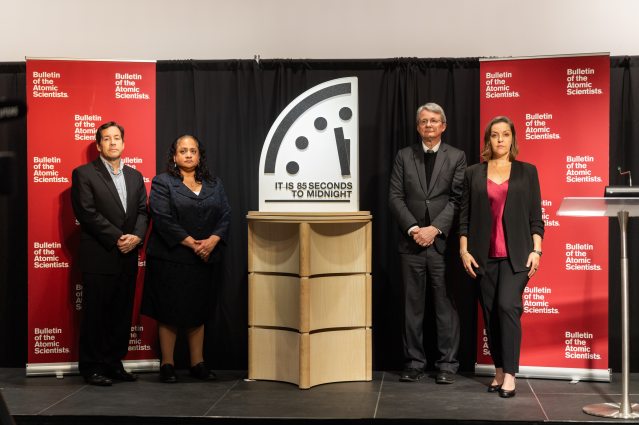
‘We are 85 seconds to midnight, the closest we have ever been to global catastrophe’
This is the sentiment and message released by the Bulletin of the Atomic Scientists in its annual Doomsday Clock setting.
This year’s Doomsday Clock setting is four seconds closer to midnight compared to its 2025 Doomsday Clock setting at 85 seconds to midnight.
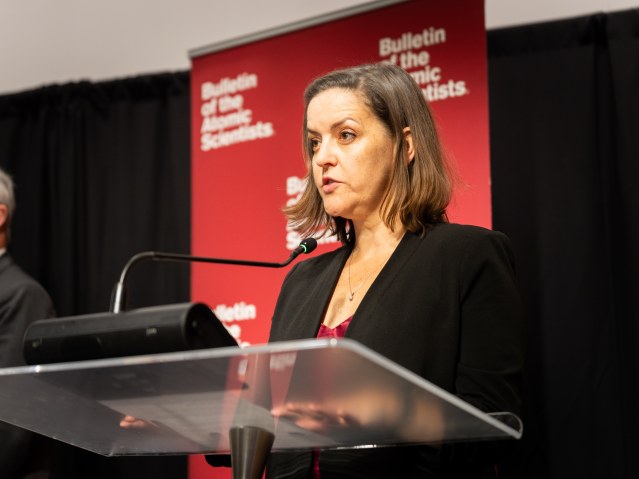
Commenting on the 2026 Doomsday Clock, the President and CEO of Bulletin of the Atomic Scientists, Alexandra Bell, said: “The Doomsday Clock’s message cannot be clearer. Catastrophic risks are on the rise, cooperation is on the decline, and we are running out of time. Change is both necessary and possible, but the global community must demand swift action from their leaders.”
The 2026 threats
In its 2026 Doomsday Clock warning, climate change featured amongst three other key threats pushing society further towards the end of civilisation.
In addition to climate risks, the US-based organisation singles out nuclear risks, biological threats and disruptive technologies as trends pushing society in the wrong direction.
The 2026 Doomsday Clock statement from the Bulletin of the Atomic Scientists.
The non-profit states that their assessment is that the Doomsday Clock in 2026 is 85 seconds to midnight. They reasoned their argument for this that they last year that the world was perilously edging closer to global disaster and that any delay in reversing this course would increase such risks. In the past year, instead of heeding this warning, led by just three countries, Russia, China and the US, as well as others, have instead become increasingly aggressive, adversarial and nationalistic.
History and context of The Bulletin of the Atomic Scientists and the Doomsday Clock
- Late 1945, Albert Einstein, J. Robert Oppenheimer, and University of Chicago scientists founded the Bulletin of the Atomic Scientists in the immediate aftermath of World War II
- Founded as a response to their roles in creating and using the world first at atomic weapon in World War II
- 1947: The Doomsday Clock was created
- The Doomsday Clock is set every year by the Bulletin’s Science and Security Board in consultation with its Board of Sponsors
- The Clock has become a universally recognised indicator of the world’s vulnerability to global catastrophe caused by man-made technologies
Apocalyptic
The Bulletin of the Atomic Scientists do not mince its words and calls these apocalyptic dangers.
The global world orders as well as global collaboration and understandings, that was built up over long periods of time are in a very short period being dismantled and is collapsing. Combined with an increase in the winner-takes-all great power competition undermines international co-operation, which the organisation reminds us, is critical for reducing the risks of nuclear war, climate change, the misuse of biotechnology as well as the potential threat of artificial intelligence (AI), as well as other apocalyptic threats.
The Chicago-based organisation argues that too many world leaders have been complicit by being complacent and indifferent, saying they, in many cases, they have adopted rhetoric and policies that accelerate rather then mitigate these risks.
That’s why the Bulletin of the Atomic Scientists Security Board have set the dial at the Doomsday Clock at, 85 seconds to midnight – it’s highest ever level.
The role of climate change
Specifically on the risks of climate change, they explain that in the past year a series of adverse trends dominated the climate outlook.
First and foremost, the atmospheric levels of CO2 reached a new high by rising 150 per cent since pre-industrial levels.
2025 started with data confirming that globally, 2024 was the warmest year ever recorded since we started to measure it.
Additionally, freshwater coming from the accelerating melting of glaciers and thermal expansion prompting global average sea level to reach a record high.
Warmer temperatures fueled an increasing level of extreme weather events with extreme and heavy rainfall and droughts across the globe. Some unwelcome highlights included severe droughts in large swaths of Peru, the Amazon, southern and northwest Africa. Europe experienced more than 60,000 heat-related deaths. In the Congo River Basin 350,000 were displaced, and record rainfall in Brazil displaced over half a million people.
The Security Board pointed out that, even in the wake of this, the national as well as international response was wholly insufficient. This was emphasised by the past three UN climate summits failed to emphasise the phasing out of fossil fuels or the monitoring of carbon emissions.
The concern and risk was emphasised further by the Trump administration declaring a war on renewables and climate policies, gutting any national efforts and mentions in policy documents and government departments.
What needs to happen now?
They urger countries and world leaders to urgently take steps to mitigate these risks and reverse course by:
- US and Russia resuming the dialogue about limiting its nuclear arsenals
- Through both multilateral agreements and national regulations, the international community should take all feasible steps to prevent the creation of mirror life and cooperate on meaningful measures to reduce the prospect that AI be used to create biological threats
- The US Congress should repudiate President Trump’s war on renewable energy and instead provide incentives and investments that will enable rapid reduction in fossil fuel use
- The US, Russia, and China should engage in bilateral and multilateral dialogue on meaningful guidelines regarding the incorporation of AI in their militaries, particularly in nuclear command and control systems
They emphasise that the current trajectory is unsustainable, and world leaders of any country, but especially those in the US, Russia and China, must take the lead in finding a path away from the brink. As the dial has reached the closest it has ever come to global catastrophe at 85 seconds to midnight, citizens must insist they do so, the Security Board stressed.
Anders Lorenzen is the founding Editor of A greener life, a greener world.
Discover more from A greener life, a greener world
Subscribe to get the latest posts sent to your email.
Categories: climate change, impacts, science, Uncategorized
 A greener life, a greener world