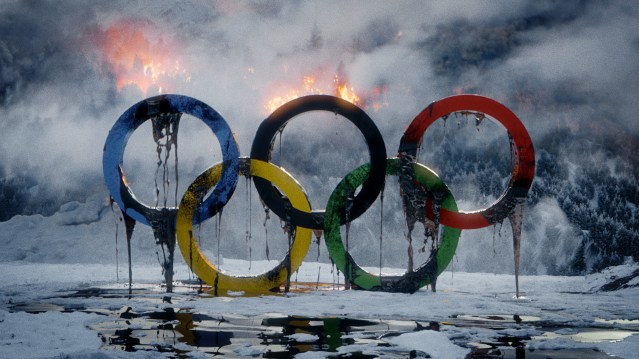
Starting today and for the next two weeks, the Italian city of Milano will host the 15th edition of the Winter Olympics.
But more so than ever before, this year’s Games will be played under the shadow of the escalating climate crisis.
Reports have indicated that the organisers have faced serious challenges with warm weather, and that temperatures have been so high that, at times, it was not even possible to make artificial snow. To use snow canons, temperatures still have to drop below 0 degrees C, and generally they’re deployed at night when the temperature drops and pistes are empty. The problem is just that it has not happened.
Additionally, the 2026 Milano-Cortina organisers have also faced widespread criticism for choosing oil and gas giants, such as Italy’s Eni, as key sponsors.
Winter Olympics in a warming climate
For much of their modern history, the Winter Olympics have relied on the assumption that cold, snowy conditions could be taken for granted. But in our warming world, that assumption no longer holds.
Across Europe’s alpine regions, average winter temperatures have risen markedly over recent decades, shortening the snow season and reducing the reliability of natural snowfall.
Climate studies cited by the International Olympic Committee (IOC) show that a growing number of former Winter Olympics host cities would struggle to meet minimum snow and temperature thresholds today without extensive artificial intervention.
That also applies to this year’s hosts. While many Milano-Cortina competition venues are located at altitude in the Alps, they are still exposed to increasingly frequent winter warm spells, particularly at the margins of the season. The result is that snow reliability has become a logistical challenge rather than a given, even before competition begins.
Where’s the snow?
Snowmaking has become central to the delivery of the 2026 Games — but even that safety net has shown its limits.
Artificial snow can only be produced within a narrow temperature range. More precisely, snow cannons typically require temperatures of around –2 °C to –4 °C or lower, depending on humidity.
This usually confines snowmaking to night-time or brief cold spells. During the build-up to the Games, organisers and local operators have faced the challenge that daytime temperatures were repeatedly too warm to allow snow production, compressing snowmaking into short overnight windows when the temperature thresholds were met.
But even that was not always an option, as at times, those windows reportedly failed to materialise at all. Prolonged mild conditions meant that temperatures did not drop sufficiently overnight, temporarily preventing snowmaking even on prepared pistes.
While organisers ultimately succeeded in laying competition-ready surfaces, the process required intensive, round-the-clock operations when conditions allowed, highlighting how marginal winter conditions have become.
Ironically, this growing dependence on artificial snow that has become necessary due to a warming climate will further exacerbate the climate crisis. Machine-made snow is denser than natural snowfall, affecting surface behaviour and requiring additional grooming. It also demands substantial quantities of water and energy — resources that are increasingly strained in alpine regions of Milano-Cortina that are already facing climate-driven stress on ecosystems and water resources, and it ramps up emissions, making it harder for the organisers to fulfil their sustainability commitments.
Fossil-fuel sponsored Games
The climate contradiction of the 2026 Games is sharpened by their sponsorship profile.
Despite the growing visibility of climate impacts on winter sports, Milano-Cortina organisers have faced criticism for accepting sponsorship from major fossil-fuel and high-emissions companies. Campaigners argue that such partnerships undermine claims of climate responsibility and risk normalising continued fossil-fuel expansion at a moment when rapid emissions cuts are required.
For critics such as Greenpeace, the issue is not only reputational. Sponsorship deals can drive additional emissions through advertising, promotion and consumption patterns that fall outside official Olympic carbon accounting, but the arguments that it should be part of the Games’ wider climate impact and carbon accounting are only growing in significance.
The Greenpeace 2026 Winter Olympics Campaign video.
Stop taking money from the fossil fuel industry
Coinciding with direct actions as well as offline and online campaigns, Greenpeace have called on the IOC to commit to dropping fossil fuel sponsorship across all Games.
Philip Evans, a senior climate campaigner at Greenpeace UK, said: “There is a gross contradiction in the Olympic values of respect for people and the environment and its willingness to continue accepting funding from the oil and gas industry that is driving the floods, heatwaves and fires that are wreaking havoc on our planet. Big Oil companies should be paying for the damages they are causing to communities around the world, not being paid to clean up their image.”
Climate-concerned athletes
Athletes themselves have become some of the most prominent voices raising an alarm.
Winter sports competitors are acutely aware that climate change is reshaping training conditions, shortening seasons and increasing injury risks due to unstable snow and ice. In recent years, a growing number of Olympians and athletes have spoken publicly about the disconnect between the celebration of winter sports and the environmental realities threatening their future. Several companies and organisations, and high-profile past and present Olympians and athletes have signed their names to this petition directed towards the Ski and Snowboard Federation (FIS) and the IOC, arguing that fossil fuel sponsorship and marketing have no place in the sport. One of the lead signatures, the Norwegian free-ride skier and YouTuber Nikolai Schirmer, travelled to Italy ahead of the start of the Games to deliver the petition to the IOC.
Schirmer said: “These companies have actively ignored the science and spent the past decades investing in ever more fossil fuels, while greenwashing themselves with marketing. Skiing can’t be complicit in that. Let’s build a better future!”
For some, Milano-Cortina has become a symbol of that tension: elite performance delivered through ever more intensive technological and environmental intervention, against a backdrop of warming mountains.
Emissions could be the highest ever
Beyond snow conditions, the climate impact of staging the Games themselves has come under renewed scrutiny.
Official estimates suggest the Milano-Cortina Winter Olympics will generate around 930,000 tonnes of CO₂ equivalent, with spectator travel accounting for a significant share. While this figure places the Games below the most carbon-intensive Summer Olympics, it is still substantial — particularly for an event so closely tied to environments already being reshaped by climate change.
Independent analyses argue that this headline number may understate the true impact. This is because emissions linked to sponsorship and promotion by high-carbon industries such as oil, gas and aviation are downplayed by official estimates. As a result, the total emissions associated with the Games could rise significantly higher, potentially making Milano-Cortina one of the most climate-intensive Winter Olympics to date.
Info-box snapshot of emissions from the previous Winter Olympics
- Vancouver 2010: ~270,000 tCO₂e
- Sochi 2014: ~520,000 tCO₂e
- Pyeongchang 2018: ~1.64 million tCO₂e
- Beijing 2022: ~490,000 tCO₂e (reduced spectator travel during COVID restrictions)
- Milano-Cortina 2026: ~930,000 tCO₂e (official estimate; higher when indirect emissions are included)
Methodologies vary between Games, but the overall trajectory highlights how travel, construction and commercial partnerships increasingly dominate the carbon footprint.
In the age of the climate crisis, is the longevity of the Winter Olympics at risk?
The challenges faced by the 2026 Games raise a deeper question about the future of the Winter Olympics themselves.
Scientific projections suggest that, without significant global emissions reductions, only a small number of current and former host regions will retain reliable winter conditions later this century. This has prompted discussions within sporting bodies about limiting host cities to a smaller, climate-resilient pool, shifting Games earlier in the calendar, or rethinking the scale and format of winter mega-events altogether.
Milano-Cortina may still deliver memorable competition, but sporting achievements risk being undertaken in the shadows of the climate crisis, and could impact safety and performance.
There will be a growing pool of people and organisations who argue that, in the extent of the intervention required, from artificial snowmaking to complex carbon accounting, is the Winter Olympics still viable in the future in the face of the escalating climate impacts and unpredictable weather impacts.
This is, of course, not a debate confined to the Winter Olympics and winter sports in general, but outdoor sports across the board, with recent Summer Olympics as well as tennis tournaments, road cycling events and running events such as marathons facing increasingly impacted by extreme heat events.
Anders Lorenzen is the founding Editor of A greener life, a greener world.
Discover more from A greener life, a greener world
Subscribe to get the latest posts sent to your email.
 A greener life, a greener world