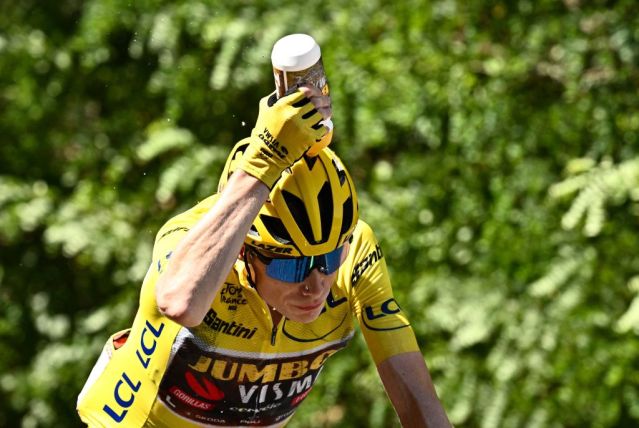
As the world’s professional road bike riders were battling rain, snow, storms and the cold to prepare for the new road cycling season, extreme heat and climate change might have been the last thing on their mind.
But as the season kicked off in Australia in mid-January, they got a break from the wintery weather in the northern hemisphere.
It was a bit more than a break, as sweltering temperatures and nearby wildfires meant that organisers had to enact last-minute changes to the race, and on this occasion, climate impacts stared the athletes straight in the face.
Professional road-cycling is just one of many sports where the accelerating impacts of climate change are bringing several challenges and disruptions in the sport.
Tour de France under threat from climate change
Now a study has looked at how climate change is impacting the most prestigious and popular cycling race in the world, the three-week-long stage race; Tour de France (TDF).
The fact that climate change has not had a more disruptive effect on the sporting race has more to do with luck than climate impacts not being felt in the region of the race, according to researchers at the French National Research Institute for Sustainable Development (IRD) who collaborated with the London School of Hygiene & Tropical Medicine (LSHTM) and the Barcelona Institure for Global Health (ISGlobal) for the study.
Researchers analysed more than 50 editions of TDF between 1974 and 2023 to evaluate how the heat stress risks the athletes are facing have evolved over time.
The TDF route is different year on year, but there are key regions that are normally featured in each edition, such as the mountain chains of the Alps and the Pyrenees and of course, the finish city of Paris.
Increasing heat risk
The study found that in the areas where the race is held as well as the time of year, heat stress risk has steadily increased over the years, with the fastest rate having been experienced within the past decade.
The scientists found that race organisers have only narrowly avoided major disruptions to the race, and in some cases, only by a matter of days or a tenth of a degree did they avoid conditions of maximum health risk.
Is luck running out?
The TDF organisers have been riding on a wave of length, the authors of the study explain. IRD researcher and lead author Ivana Cvijanovic said, “In our analysis, we observe that the city of Paris, for example, has crossed the high-risk threshold for heat on five occasions in July, four of them since 2014. Other cities have experienced many days of extreme heat in July, but thankfully not on the date of a Tour de France stage.”
But that luck will inevitably run out, as Cvijanovic continues, “In a way, we can say that it is an extremely fortunate race, but with record-breaking heat waves becoming more frequent, it is only a matter of time before the Tour encounters an extreme heat stress day that will test existing safety protocols.”
The areas around Toulouse, Pau and Bordeaux in southwestern France and around Nimes and Perpignan in the southeast have most often experienced dangerous heat levels. But Paris and Lyon are catching up and are also crossing the high-risk heat threshold, emerging as new heat stress hotspots.
The cycling sport needs to adapt
Desislava Petrova, researcher at ISGlobal, offered some advice to the race organisers when planning the route, “Extra caution should be exercised when planning stages in these regions,” she said.
The iconic and legendary mountain stages ascending the mountain passes of Col du Tourmalet and Alpe d’Huez have historically remained within the low to moderate heat stress risk thresholds, where there have been no recorded episodes of extreme heat risk to date.
But this could all be about to change, and it points to the important factor of the time of day the event is held. Unsurprisingly, the analysis shows that morning hours remain the safest part of the day, while high heat stress levels can linger until late afternoon.
If organisers were to heed these warnings, it could prevent them from having a headache as the athletes have to start early in the morning if the stage finishes on top of one of those mountain passes, which could present opposition from athletes, sponsors and the media.
But the researchers are clear about what needs to happen as they set out that these patterns show the need to adapt these schedules, routes and safety protocols in order to reduce the risks to athletes, cyclists, event staff and spectators.
On a scientific level, there’s still more to uncover in how the human body responds to heat stress, but we know that when the body is under stress from heat, it not only impacts athletic performances but can also be fatal.
Anders Lorenzen is the founding Editor of A greener life, a greener world.
Discover more from A greener life, a greener world
Subscribe to get the latest posts sent to your email.
Categories: climate change, Health, science, Sports, Weather
 A greener life, a greener world