
By Jeremy Williams
Tom Steyer is one of the world’s more interesting billionaires. He made his fortune as an investor and then sold up to become a full time climate campaigner. He worked on the carefully targeted ’50 by 30′ campaign that helped to normalise renewable energy targets in US states, and founded the youth democracy organisation Nextgen. He even ran for president in 2019 to push climate up the agenda, because any you can do that in America if you have a spare billion or two.
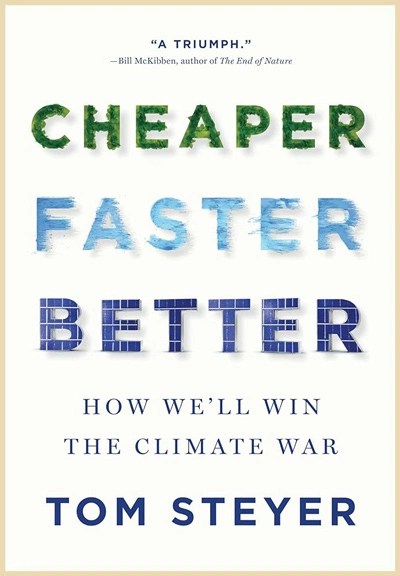
Now, his experience has been parlayed into this book, Cheaper Faster Better: How we’ll win the Climate War.
The subtitle is instructive. Steyer draws explicit parallels between the Second World War and climate change, of how the war called on the civilian population to step up, and the pride that people took in their role. Climate change may offer its own equivalent of that perennial question: “what did you do in the war?” Preventing climate disaster will take all of us, and some people are going to squirm uncomfortably when the question comes their way in future.
There’s also a clear enemy in Steyer’s mind, and the role of the fossil fuel industry in delaying and obstructing change is a recurring theme throughout the book. There are people who profit from the status quo and will do anything to keep the world burning oil and gas for as long as possible. It is possible to overplay the enemy narrative, but it’s also naive to ignore the power dynamics at work around climate. Steyer treads a pretty good balance.
Because he has his eye on industry, Cheaper Faster Better is particularly good on the subject of personal responsibility and ‘carbon shaming’. Doing as much as we can does not mean obsessing over our own carbon footprints. We should direct our attention to what matters most, which is systemic change and politics, not little lifestyle changes.
“Turning a collective problem into a matter of individual responsibility is exactly what the fossil fuel industry is trying to do,” writes Steyer. “If every climate activist who ever made a non-climate neutral decision lost all credibility or became wracked with guilt, the oil and gas companies would win easily. We need systemic change, not perfect people – because perfect people don’t exist.”
Another thing that I enjoyed about the book is that Steyer draws anecdotes from his life in business and investment. There aren’t many climate authors with this kind of background, and so the book has some more unusual parallels and metaphors – potentially ones that will resonate with a different audience. In a chapter on how to “sharpen your bullshit detector”, Steyer describes a notorious Italian investor known as the Pasta King. He would come to New York once a year to buy investments, and brokers would pitch their worst stock to him as he had a reputation for being spectacularly gullible. “Don’t be the Pasta King” is Steyer’s message as he writes about greenwash and tokenism.
On the less positive side, this is a very American book. Each chapter concludes with a profile of a ‘climate person’ we can learn from, all of them American. The rest of the world barely registers, even when writing about climate justice, which Steyer understands and has campaigned on. That would be just about acceptable if Steyer didn’t insist at various points that the US is going to lead the world on climate. “This is America’s opportunity to do what our country does best, what the greatest generation did all those years ago: we can lead the world. We can save the world. And we can make a ton of money in the process.”
It’s hard to lead the world from the back of the field while ignoring the contributions of everyone else. So, if you’re reading this outside of the US, you’ll have to hold your nose through these passages. That aside, I liked Cheaper Faster Better, and it’s certainly a lot more useful than another climate bestseller by a billionaire that I could mention…
First published in The Earthbound Report.
Discover more from A greener life, a greener world
Subscribe to get the latest posts sent to your email.
Categories: book review, climate change, Reviews, US
 A greener life, a greener world