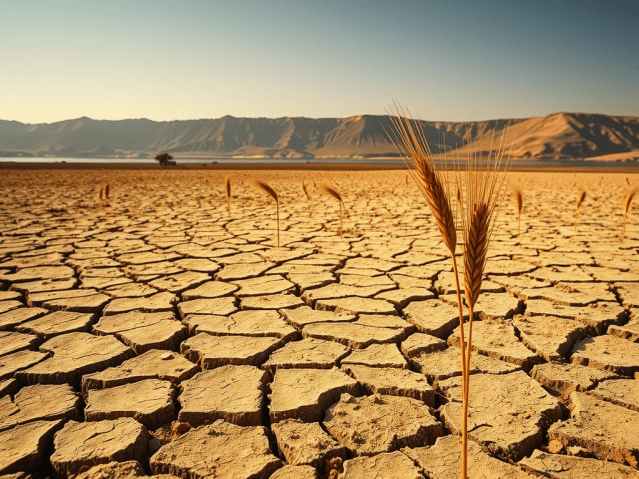
The Gulf state of Iraq has experienced unprecedented drought conditions in 2025, so severe that it is threatening the viability of stable wheat production in the country.
In 2025, fuelled by climate change has seen one of the driest years on record in the country which has experienced record-low rainfall in the Tigris-Euphrates basin. The basin is a key agricultural region in the country due to the river system.
The five-year drought
This comes on the back of a five-year drought in the region, which scientists say is linked to climate change.
The water levels in the two main rivers forming the basin, the Tigris and the Euphrates rivers, have plunged to record lows, and as a result, the available water for irrigation has been significantly reduced.
For the Tigris, the impacts are so severe that some parts of the river are at risk of disappearing altogether. In addition to climate impacts, pollution, upstream damming, and declining flows are contributing to the demise.
A heavy price
Iraq’s agricultural sector, and in particular the wheat industry, is paying a heavy price for the climate-driven extreme weather patterns.
Preliminary data from the government’s Agriculture Ministry has estimated a significant drop in wheat output compared with 2024. They estimated that this year, just 5.12 million tonnes of wheat were produced, down from 5.4 million tonnes in 2024.
Crisis averted, for now
However, the poor harvest of 2025 has not hit a crisis point yet due to strategic reserves were sufficient to meet demand. Though if the conditions do not improve, the crisis could be delayed to next year, especially since this year’s poor harvest has depleted its reserves.
Outlook for the 2025/26 harvest season suggests that harvest output could be reduced by as much as 30-50% which would force the country to import 2.4 million tonnes.
The long-range forecast is not looking good for the country. Not only is Iraq ranked as one of the world’s most climate-vulnerable countries, but future climate change projects indicate higher temperatures and reduced rainfall.
Wheat is the most dominant and important crop in Iraq’s agricultural economy.
Anders Lorenzen is the founding Editor of A greener life, a greener world.
Discover more from A greener life, a greener world
Subscribe to get the latest posts sent to your email.
Categories: Agriculture, climate change, economy, Middle East
 A greener life, a greener world