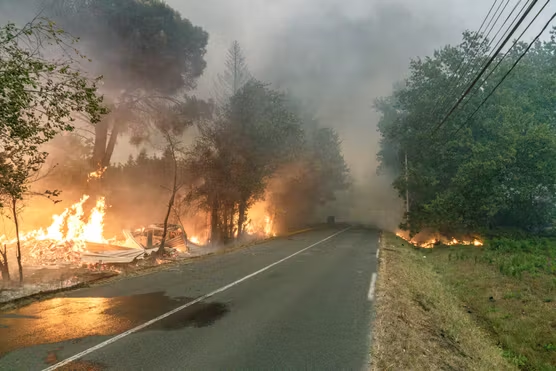
On Tuesday evening, thousands of firefighters were continuing their battle against one of the largest wildfires in modern French history.
The massive and fast-spreading fire began after a blaze tore through forests in the regions of Gironde and Landes located in the southwestern part of the country.
The rapid spread of the mega-fire subsequently forced the evacuation of hundreds of thousands of people and positioned one of the most severe fights against the climate crisis that the European continent has ever faced, with 2026 being without comparison the most severe wildfire year Europe has ever faced. This has been reached while only just over halfway through the European summer.
Gironde: A European mega-fire
The fire, fuelled by hot, dry and windy conditions, has burned approximately 42,000 hectares (ha) of mainly pine forest, destroyed homes and businesses, and disrupted communities across one of France‘s most important forestry regions.
More than 220,000 people have been evacuated from Gironde, with tens of thousands more leaving neighbouring areas as the fire spread rapidly through dense woodland.
Aided by assistance by it’s European neighbours and the European Union (EU), the French authorities have deployed thousands of firefighters, supported by aircraft, military personnel and emergency services.
Its endeavour to contain a mega-fire so large that it at times generated its own weather through towering pyrocumulonimbus clouds is an ongoing and uphill battle. These so-called “fire clouds” can create strong winds, turbulence and even lightning, making wildfires significantly harder and more dangerous to control.
While authorities say they have finally got the fire under control, a new heatwave has landed in France and its neighbouring countries; that and a sudden pick-up in wind speeds could quickly bring the fire out of control.
Gironde: A defining climate-fueled disaster
The Gironde wildfire has become one of the defining natural disasters of Europe’s 2026 wildfire season, which has already seen major fires across Spain, Italy and parts of the Balkans.
According to the latest data from the European Forest Fire Information System (EFFIS), more than 250,000 ha have already burned across the European Union (EU) this year, well above the long-term average for this stage of the fire season. The combination of prolonged drought, repeated heatwaves and dry vegetation has created ideal conditions for large, fast-moving fires across southern Europe.
While wildfires have always occurred in Mediterranean climates, scientists have warned that climate change is increasing the frequency of the extreme weather conditions that allow fires to spread rapidly and burn with greater intensity. Rising temperatures, longer periods without rainfall and more frequent heatwaves are extending the traditional wildfire season and increasing fire risk across much of Europe.
Gironde wildfire: Key facts
- Location: Gironde and Landes, southwestern France
- Estimated area burned: Approximately 42,000 hectares
- Evacuations: More than 220,000 people in Gironde, with additional evacuations in neighbouring areas
- Response: Thousands of firefighters supported by aircraft and military personnel
- Main drivers: Extreme heat, prolonged drought, low humidity and strong winds
- European context: More than 250,000 hectares have burned across the EU during the 2026 wildfire season so far.
Gironde: Firefighters continue an uphill battle
Emergency services continue to face difficult conditions as changing winds and high temperatures complicate firefighting efforts. Authorities have urged residents to follow evacuation orders and remain vigilant as weather conditions remain favourable for further fire activity.
Although some progress has been made in containing parts of the blaze, officials warn that the situation remains highly dynamic and that flare-ups remain possible until cooler temperatures and sustained rainfall arrive.
Long-lasting environmental and economic damage
Beyond the immediate danger to human life and property, the Gironde wildfire is expected to leave long-lasting environmental and economic consequences.
The affected area contains extensive maritime pine forests that support biodiversity, timber production and local tourism. Large-scale fires also release significant quantities of stored carbon back into the atmosphere, temporarily turning forests from carbon sinks into sources of greenhouse gas emissions.
Smoke from the fires has affected air quality across western France, while damage to forests and infrastructure is expected to take decades to fully recover.
Europe enters another challenging wildfire season
Experts say that the wildfire in Gironde serves as another reminder of Europe’s growing exposure to extreme weather events.
Recent years have seen record-breaking fires across Portugal, Greece, Spain and France, with wildfires increasingly affecting regions previously considered at lower risk. Researchers continue to investigate how a warming climate is altering wildfire behaviour, while governments across Europe are expanding investment in prevention, early detection and emergency response.
With little respite from months of persistent dry conditions and another heatwave having just landed in the country and parts of southern Europe, fire authorities remain on high alert as the 2026 wildfire season continues with the sobering reality that the worst may still be to come.
Anders Lorenzen is the founding Editor of A greener life, a greener world.
Discover more from A greener life, a greener world
Subscribe to get the latest posts sent to your email.
 A greener life, a greener world