By Anders Lorenzen
Norway has long been known as the world leader in the uptake of electric vehicles (EVs), but they could face competition from their Scandinavian neighbour; Denmark.
Data from Mobility Denmark shows that of all the 19,531 new car registrations in the past year in Denmark, a staggering 50.9% of those were EVs. This is compared to 34.7% in the previous year, 17.4% in 2022, 11.2% in 2021, and 4.6% in 2020, which shows a remarkable rise in the past five years.
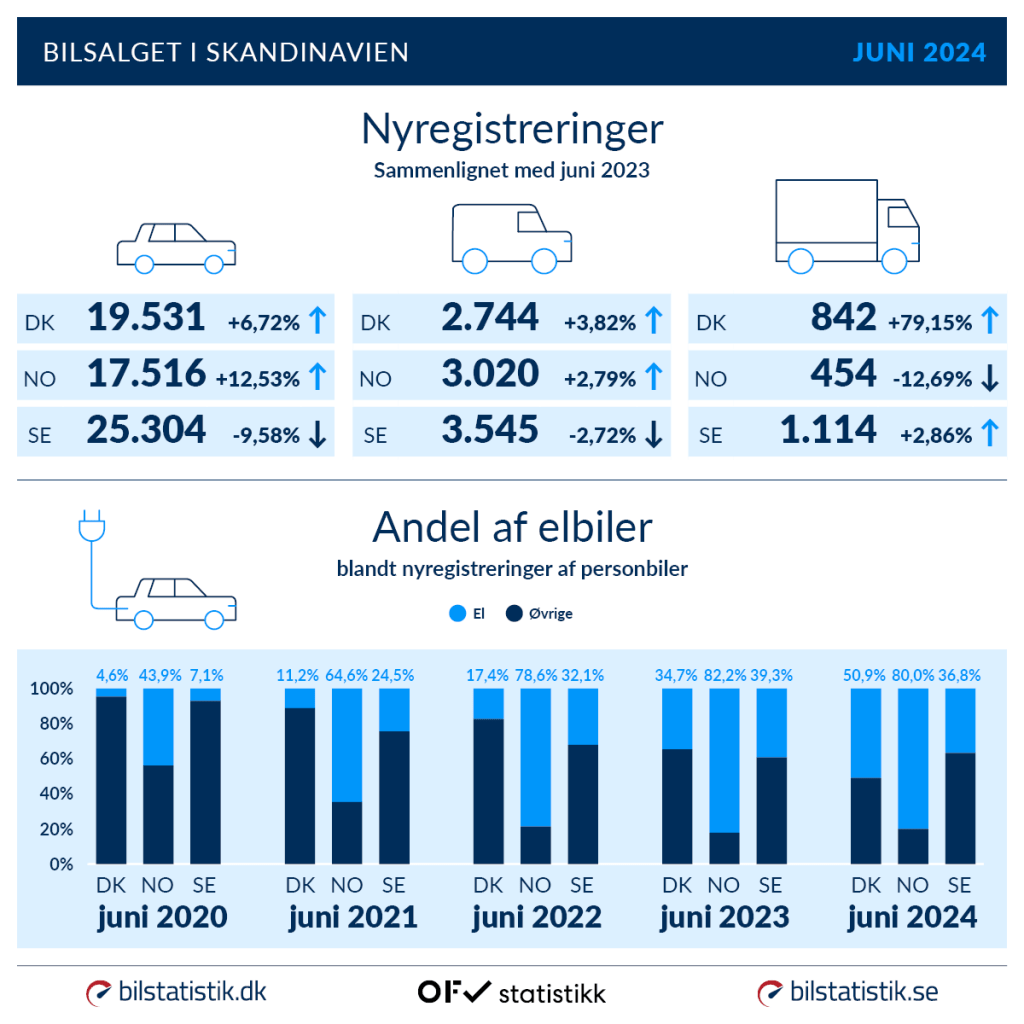
It is still some way off Norway’s numbers for the same years of 80%, 82.2%, 78.6%, 64.6% and 43.9% respectively. Norway’s data is in fact seeing a decline, while Denmark’s is rapidly increasing.
Keeping cost down
The Director of Mobility Denmark, Mads Rørvig, believes that in order to continue this growth it is important to keep the costs and taxes on EVs down, “by doing that we increase the possibilities for people to decide to purchase an EV, this is the key factor for the transition”, he added.
According to Mobility Denmark data, there currently are 388,296 EVs and plug-in-hybrid registered cars in Denmark. At the end of 2023, there were 2,82 million registered cars in Denmark.
The most popular newly registered cars in Denmark in the past year are the two EV models, the Tesla Model Y and 3.
The rapid growth of the EV charging network, the decreasing cost, increase in efficiency and range compared to many more models, are all contributing factors to the appeal of purchasing an EV.
Mobility Denmark is the trade and industry body for car producers, car importers, charging operators, financing and car renting companies.
Discover more from A greener life, a greener world
Subscribe to get the latest posts sent to your email.
 A greener life, a greener world
These numbers are not annual. They simply compare June 2023 to June 2024. You honestly thought there were just 19,531 car registrations in DK in a year? That’s for June 2024, only.
DK is seeing a massive influx of BEVs, so the story is still valid. Look into the massive import of cars into DK as well. 4,000-5,000 BEVs are being imported each month also.
Finally, I think it is interesting to look at households vs corporate BEV purchases. Households are driving this push. In June 2024, 71% of cars sold to households were BEVs – which drops to around two thirds when you look at the year.
LikeLike