Editorial note: This article was updated on the 22nd of March 2025 to reflect technical and layout changes.
Please note that this article relates to the G7 summit in 2018 and remains intact in its original form. Our latest updates on the nature of what is discussed in the article below are in our International Politics section.
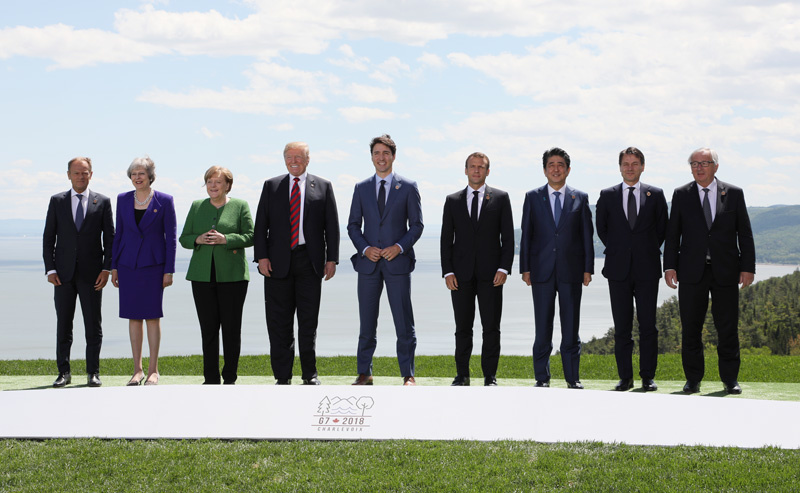
Drama erupted in Canada this month when the annual G7 summit was held in Charlevoix in the French-speaking province of Canada, Quebec. The illustrious club, G7, includes seven of the world’s largest economies, US, Canada, Japan, UK, Germany, France and Italy.
In unusual fashion, as the world has become accustomed to during his presidency, the US President was the architect of that drama.
Sticking points
As the two-day summit progressed it became clear there were several sticking points in negotiations that Trump could not agree to, and he conveniently left the summit early just before the focus moved towards climate change and plastic pollution.
Ah he jetted off to Singapore for the much-hyped meeting with North Korean leader Kim Jong-un, the summit convened.
A year ago, Trump controversially announced that he would withdraw the US from the UN climate treaty, the Paris Agreement.
Trump drama
However, it appeared that across the board there had been some agreement and the US had said they would sign up to the G7 Communique.
However, on the last day of the summit, the world abruptly woke up to yet another Twitter tirade from Trump, attacking almost every single world leader at the summit.
Hairdryer treatment
But the summit’s host, Canada’s Prime Minister Justin Trudeau, received the hairdryer treatment, with Trump calling him weak and dishonest.
However, the remaining six countries and the EU quickly reaffirmed that they stood by the communique just as the world said they stood by The Paris Agreement when Trump announced the US would exit.
Tackling climate change and plastic pollution, albeit at the bottom of the document, was at least given its own section, which sets this summit apart from previous G7 meetings, where critics commented on the omission of these critical issues.
Focus on climate
The communique outlined that the countries set the path to a sustainable and resilient future that creates jobs and which promotes participation and leadership of young people, specifically young women, through sustainable development.
Energy security
They committed to strengthening energy security while making sure that energy systems drive sustainable economic growth. It did not set out how each individual country should reduce emissions, but it recognised that each should decide how best to achieve a low-emission future.
That paragraph is almost taken out of the agreed The Paris Agreement textbook.
All countries, bar the US, reaffirmed their commitment to implementing the agreement. They did, however, reach an agreement that part of the path to get there would be fulfilled through innovation, climate finance, and energy transitions through market-based clean energy technologies. Crucially, it acknowledged the role of carbon pricing.
Canada controversy
The two words of ‘just transition’ could very well have been argued for by Justin Trudeau as he has lately become under fire for the carbon-heavy path that Canada is taking, with the government having just bought the Kinder Morgan oil pipeline.
It cannot be ruled out that he would have been seeking guarantees that there still should be room for developing fossil fuel-based economies.
Collaborative partnerships to fight climate change
The six countries and the EU said they would promote the fight against climate change through collaborative partnerships and partners at all levels of government, the private sector, global organisations, NGOs, and indigenous and remote coastal and small island communities.
Action on ocean pollution
A section followed on protecting the world’s oceans saying that they recognise that healthy oceans and seas directly support the livelihoods, food security and the economic prosperity of billions of people.
A blueprint for healthy oceans
A second document was created, the Charlevoix Blueprint for Healthy Oceans, Seas and Resilient Coastal Communities, which they endorsed. They said they will improve ocean knowledge and promote sustainable fisheries as well as support resilient coasts as well as coastal communities and address plastic waste and marine litter.
They highlighted, though, that plastics do play an important role in our economy and daily lives but that the current plastic approach poses a significant threat to the marine environment, livelihoods, and human health. Therefore, the six countries and the EU endorsed the G7 Ocean Plastics Charter.
Anders Lorenzen is the founding Editor of A greener life, a greener world.
Discover more from A greener life, a greener world
Subscribe to get the latest posts sent to your email.
Categories: climate change, environment, world politics
 A greener life, a greener world
17 replies »