April 2026 – Week 3
As part of an expanded focus on real-time coverage, this live blog tracks developments across global energy markets, including electricity prices, oil and gas benchmarks, and renewable generation trends.
It is updated throughout the week with the most significant developments around energy and related markets with a sustainability lens.
Last week’s live blog can be found here.
Key developments we are tracking this week:
- Volatility across oil, gas and electricity markets
- Clean energy’s response to the energy crisis
- Policy shifts driven by the energy crisis
This liveblog is now closed, but you can see our latest and currently active live blogs here.
Latest
Monday 27th of April 2026
10:40 GMT
We are wounding up this blog now, you can follow this weeks developments in this live blog.
Sunday 26th of April 2026
23:40 GMT
Oil price: In early trading as Asian markets opened Monday morning, the oil price has surged.
Brent Crude and WTI is up more than 2% at $108/bbl and $97/bbl respectively.
21:00 GMT
Jet fuel: Further blow to airline industry as the Brazilian petrochemical giant Petrobras will reportedly raise jet fuel prices by 18% in May.
Saturday 25th of April 2026
12:35 GMT
Policy: Meanwhile over 50 countries are gathering in Colombia for the conference on transitioning away from fossil fuels. The conference concludes next week on Wednesday the 29th.
We are covering this in the live blog below:
12:30 GMT
Oil price: As the market closed yesterday the price of Brent Crude remained fairly stable with change of less than 0.5% while WTI dropped by 3%.
Friday 24th of April 2026
22:15 GMT
Oil supply: Fatih Birol, the IEA’s Chief Executive, have issued another warning, this time saying that the oil and gas sector will be forever changed by the war in Iran and the resulting energy crisis.
The head of the energy analysis and forecasting agency believes that the crisis had dealt a severe blow to the trust in fossil fuels as energy security and will only speed up the transition to renewables, nuclear and electrification which will eat into oil demand.
17:15 GMT
Politics: The Prime Minister of Spain has laid out the clear energy and climate ambition and direction of the Spanish government:
15:30 GMT
Financial markets: Learn more about that extraordinary BP shareholder revolt in our article below:
11:30 GMT
Oil price: In the last trading hours on Thursday and in early trading on Friday, the oil futures has continued its steady climb with Brent Crude rising to $107/bbl and WTI continued to edge closer to the $100 mark at $98/bbl. This represents the 5th consecutive day where both benchmarks have increased.
This should be seen in the light of little progress between in the negotiations between the US and Iran, and the increased warnings from the IEA about the ever tightening oil supply and the cancellations of flights due to the rising costs of jet fuel.
Thursday 23rd of April 2026
17:00 GMT
More info on BP’s shareholder defeat, we have been sent reactions and insights from the UK investment company Hargreaves Lansdown.
The company’s ESG analyst, Joshua Sherrard-Bewhay told us:
Today, reports suggest investors decided to reject BP’s proposal to revoke former shareholder resolutions from 2015 and 2019, relating to climate reporting and strategic alignment with the goals of the Paris Agreement.
This shows that appetite is still strong for Paris alignment and climate disclosures across the BP shareholder base.
18% of investors have also been reported to vote against the election of BP Chair Albert Manifold, including those expressing concern with the exclusion of a climate resolution from the 2026 ballot. Following this proposal they requested disclosure on how BP would create shareholder value under a scenario of declining demand for oil & gas.
He further explained that while overall their investors was comfortable investing in oil and gas, they were adamant that oil and gas companies should engage with climate change reporting and risks and not depart from it, adding:
Around 25% of investors are also reported to have supported ACCR’s resolution requesting clarity on how oil & gas exploration creates long-term value for shareholders.
We surveyed Hargreaves Lansdown investors in 2025, and most respondents expressed comfortability in investing in oil and gas. Equally, 35% of those surveyed want engagement on climate change to be prioritised across the board.
These findings signal that a fair portion of retail investors expect active engagement with oil & gas companies on climate risk.
Earlier updates
16:45 GMT
Financial markets: The British oil giant BP has been dealt a major blow after the majority of its shareholders voted against resolutions to revoke its climate disclosures and Paris alignment which was adopted in 2015 and 2019 resolutions respectively.
BP has been on a rollercoaster in recent years after first firmly committing around net-zero and stronger climate targets during the reign of its CEO Bernard Looney. His departure in 2023 and the appointment of his replacement Murray Auchincloss as CEO and then replacing him with Meg O’Neill who joined from the Australian energy giant, Woodside Energy, in April 2026. This kicked of the company’s departure from net-zero and the energy transition, renewing its closer ties to the petrochemical sector.
You can read our analysis of BP’s departure from net-zero below:
15:35 GMT
Oil supply: The Economist reports that so far, being 50 days old, the war in Iran has reduced oil output in the region with about 550 million barrels of crude oil – equivalent to 2% of last year’s global output.
15:15 GMT
Jet fuel: The German airline giant Lufthansa have announced it is cutting 20,000 short-haul flights from it’s summer schedule due to the surging price of jet fuel costs.
In recent months, the cost of Jet fuel has been soaring in line with the rising oil price. Since the conflict in the Middle East started, the cost of the main jet fuel benchmarks have increased by roughly 15%.
The announcement by Lufthansa comes in the wake of the announcement by another airline giant, the Dutch KLM, who last week cancelled 160 flights for the coming month.
11:30 GMT
Our weekly updated natural gas benchmarks shows that across the board global gas prices continued to edge higher over the past week, with all major benchmarks recording gains amid a mix of geopolitical tension and shifting seasonal demand.
In Europe, the benchmark TTF rose to $15.20/MMBtu (≈€52.0/MWh), up 4.8% week-on-week, while the UK’s NBP increased to $15.80/MMBtu (≈€54.0/MWh), a 3.9% rise.
Asian LNG prices also strengthened, with the Japan Korea Marker climbing to $21.50/MMBtu, up 4.9%, maintaining a clear premium over European hubs.
In North America, movements were more modest. Henry Hub edged up 1.6% to $3.15/MMBtu, while Canada’s AECO rose 3.2% to $1.60/MMBtu.
The latest increases build on a rebound from early April lows, with European prices rising from around $13.8/MMBtu at the start of the month. However, they remain well below the elevated levels seen in late March and far from the extremes of the 2022 energy crisis.
Gas remains the marginal fuel across much of Europe and parts of Asia, and the volatile price meaning even moderate price increases can feed through into sudden surge in the price of electricity, which our European electricity data page confirms. C
11:00 GMT
Oil price: Oil futures has continued its moderate climbs on Thursday morning GMT time with Brent Crude at $104/bbl and WTI rising to $95/bbl.
According to the market analysts StanChart, the oil futures have entered a new phase where markets are being driven by geopolitically headlines, with tight physical supply and disrupted flows forcing major production cuts in the Gulf.
The analysts expect sustained higher oil prices, even post-conflict.
Wednesday 22nd of April 2026
16:00 GMT
Electricity market: A new report have found that the countries in the EU with the highest share of clean energy capacity is to combined save a whopping €5.8 billion on their energy bills.
The research by the Centre for Research on Energy and Clean Air (CREA) have found that the energy bills in Denmark, Finland, France, Sweden and Slovakia will be 58% lower than those with the dirtiest energy mix in Poland, Italy, Greece, Estonia and the Netherlands.
15:30 GMT
Oil price: With the US markets being a couple of hours old oil futures have continued to rise with Brent Crude having topped the $$101/bbl for the first time since the 13th of April and WTI risen to $91/bbl.
13:00 GMT
Oil supply: The world’s global crude oil inventories are nearing record-lows, which even in the event of re-opening of the Strait of Hormuz could take the oil sector months to recover.
Tuesday 21st of April 2026
22:45 GMT
Oil markets: Oil futures have surged in late trading, reacting to Trump saying they would not extend the ceasefire with Iran. Brent Crude rose to $99/bbl and West Texas Intermediate to $90/bbl—both up 4% from Monday’s close.
We would likely experience more volatility in early trading on Wednesday as Trump have since u-turned after pressure from Pakistan saying that they will extend the ceasefire with Iran. This sudden shift would likely result in a drop in the oil futures.
16:30 GMT
Electricity market: Reaction have come in to Miliband’s speech.
The Head of Policy Engagement at the Smith School of Enterprise of Environment, University of Oxford Dr Anupama has offered her thoughts on what Miliband announced:
Britain is facing the biggest energy price shock in a generation. Sadly, we’ve been here before – and for the second time in less than five years, we are left to imagine how much more resilient the country would be now if we had moved faster in previous years. Miliband is right to focus on building out a modern 21st century clean energy system at pace, rather than lock us deeper into fossil fuel systems predicated on expensive and seemingly unending geopolitical conflicts.
It is also correct to say that the benefits of the clean energy transition risk accruing only to the richest in society. Our analysis shows that UK households already experience uneven retail electricity bills. This is why we need good policies designed to carry the most vulnerable households through the transition.”
Finally, by choosing to ignore the costs of inaction, as some are choosing to do, the reality of climate change – over which there is an established global scientific consensus – also risks being ignored. Oxford research has shown how dangerously unprepared the UK is for climate impacts like heatwaves, fires and floods. Britain’s global leadership matters more than ever when nearly half of the world’s population will be exposed to extreme heat if the world passes 2 degrees of global warming.
16:15 GMT
Last weeks live blog: If you missed our updates last week, you can access it below:
16:10 GMT
Electricity market: More on those UK government policy announcements.
- Voluntary long term fixed contracts is offered to existing low-carbon generators that are not that are not currently on fixed contracts – this accounts for one third of UK’s electricity supply.
- An update to the Electricity Generators Levy to tax excess profits by raising it from 45% to 55%.
These represents the biggest policy changes, but several other policies updated or announced to either help consumers with the cost of energy or speeding up the energy transition – you can read the full announcements here.
Commenting on these policy changes, UK Prime Minister Keir Starmer said:
We need to get off the fossil fuel rollercoaster – this will make energy bills more stable and take the pressure off family budgets. When global gas prices spike, people here shouldn’t be picking up the tab. Our focus is simple: easing pressure on household budgets now, while building a homegrown energy system that protects families from global instability in the years ahead.
Adding to Starmer’s comments, Energy Secretary Ed Miliband said:
As we face the second fossil fuel shock in less than 5 years, the lesson for our country is clear: The era of fossil fuel security is over, and the era of clean energy security must come of age. That’s why we’re doubling down on clean power, to give our country energy security and bring down bills for good.
13:30 GMT
Electricity market: As mentioned yesterday, UK’s Energy Secretary, Ed Miliband, has delivered a speech on the crisis, and the actions the governments are taking, with reforming the electricity market being the biggest policy change. He argued this is not the time slow down the energy transition, rather the opposite. He also added that a renewed push for the UK to extract more fossil fuels will not bring down bills as they are traded and sold on the global markets.
Video: Ed Miliband’s speech (21 April 2026)
Ed Miliband’s speech on reforming the electricity market. Video courtesy of the Department for Energy Security and Net Zero.
10:50 GMT
Electricity market: Meanwhile, Ember has just published its 2026 Global Electricity Review which highlights that the surge of solar power in 2025 have stalled the rise of fossil fuel generated electricity.
10:40 GMT
Solar power: According to Jenny Chase – solar analyst at Bloomberg NEF (New Energy Finance), the Chinese government is concerned by an oversupply of solar panels in the country – which on its own outstrips global demand.
10:30 GMT
Electricity market: The UK government is planning to shake up the electricity market, reshaping how it is priced to tackle high and volatile electricity prices – making the price less reliant on volatile and sudden rise in natural gas.
We track Europe’s electricity prices daily, you can view the daily price changes in our electricity data dashboard tracking selected European countries.
Monday 20th of April 2026
18:00 GMT
Donald Trump seems to contradict his energy secretary – see our previous update on petrol prices.
The US president says Wright is wrong about petrol prices and that they will come down as soon as the war ends.
15:30 GMT
Petrol prices: Meanwhile the US Energy Secretary Chris Wright have warned that the price of petrol in the US is likely to remain above $3 per gallon until next year.
Last month the average US petrol price rose from under $3 to over $4 per gallon for the first time since 2022. In December 2025 it dipped as low as $1.8 per gallon.
15:15 GMT
Electric vehicles (EV’s): The trade association E-Mobility Europe has published data showing that the sales of EV‘s in Europe surged in March due to the soaring increase in the price of petrol as a result of the energy and oil crisis.
Data showed that the sale of new EV’s surged by 51% in March which amounted to 224,000 new EV passenger car registrations across 15 European markets.
Responding to the research, Chris Heron, Secretary-General of E-Mobility Europe, said:
“March’s surge in electric car sales is one of Europe’s biggest recent gains in energy security, in a month when oil dependence has become a real vulnerability. Across the EU’s major markets, EV sales are growing at rates above 40%, marking a clear step change, not statistical noise. That translates into half a million electric cars registered so far this year, cutting roughly two million barrels of oil demand annually.”
13:00 GMT
Energy policy: While other countries are pulling back on net-zero goals, the UK is doing the opposite.
The Guardian reports that the UK Energy Secretary Ed Miliband is to, as a direct result of, the energy crisis speed up the net-zero strategy.
In a speech to be delivered tomorrow, Miliband is expected to say, “As we face the second global energy shock in less than five years, the lesson for our country is clear; the era of fossil fuel security is over, and the era of clean energy security must come of age.”
10:45 GMT
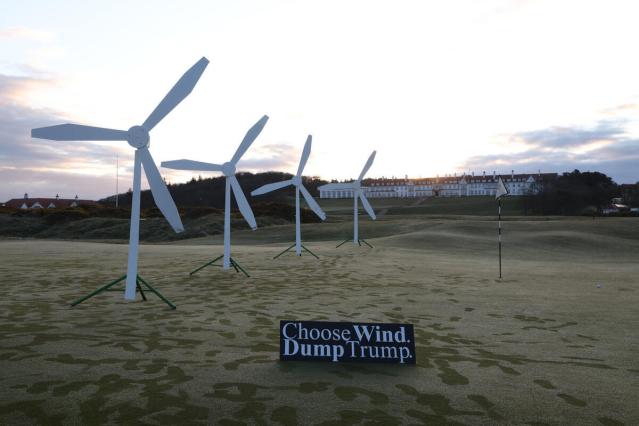
Climate activism: Greenpeace installed mock-up wind turbines on a green at Trump Turnberry Golf Club, alongside a sign reading “Choose wind, dump Trump.”
Video: Greenpeace action at Turnberry Golf Course (20 April 2026)
Montage showing installation of mock-up wind turbines at Trump Turnberry Golf Club.
In a statement, Lily-Rose Ellis, Climate Campaigner for Greenpeace UK, explained the move:
“Donald Trump wants to keep us as lifetime members of his Golf Club, where every time he starts an illegal war, bills go through the roof while his fossil fuel backers make billions. But we don’t need to stay stuck in his sand trap – the renewables Trump hates are the best insurance policy against the chaos he’s unleashed.”
The action targets fossil fuel policy debates and comes amid heightened volatility across global energy markets.
09:30 GMT
Wind power: Data released by the Energy intelligence firm Montel EnAppSys, shows that UK wind power generation reached a new quarterly record in the first quarter of 2026 reaching 29.2 terawatts (TWh), more than any other quarter.
The record figures represents a 31% increase on the 22.3 TWh which was generated in Q1 2024, and it surpassed the previous quarterly high of 28.4 TWh set in Q4 2025.
January alone set a new monthly generation record with generation of 10.6 TWh.
The surge reflects a combination of new offshore capacity and strong wind conditions, helping to reduce reliance on gas-fired generation during peak winter demand.
02:00 GMT
Oil markets: As flagged last week, escalating tensions around the Strait of Hormuz are now feeding through to markets. In early Asian trading, Brent Crude rose to $97/bbl and West Texas Intermediate to $91/bbl—up 6% and 7% respectively from Friday’s close.
We began tracking Brent Crude and West Texas Intermediate (WTI) prices last month. Full weekday data is available below.
Discover more from A greener life, a greener world
Subscribe to get the latest posts sent to your email.
Categories: Energy, live updates
 A greener life, a greener world