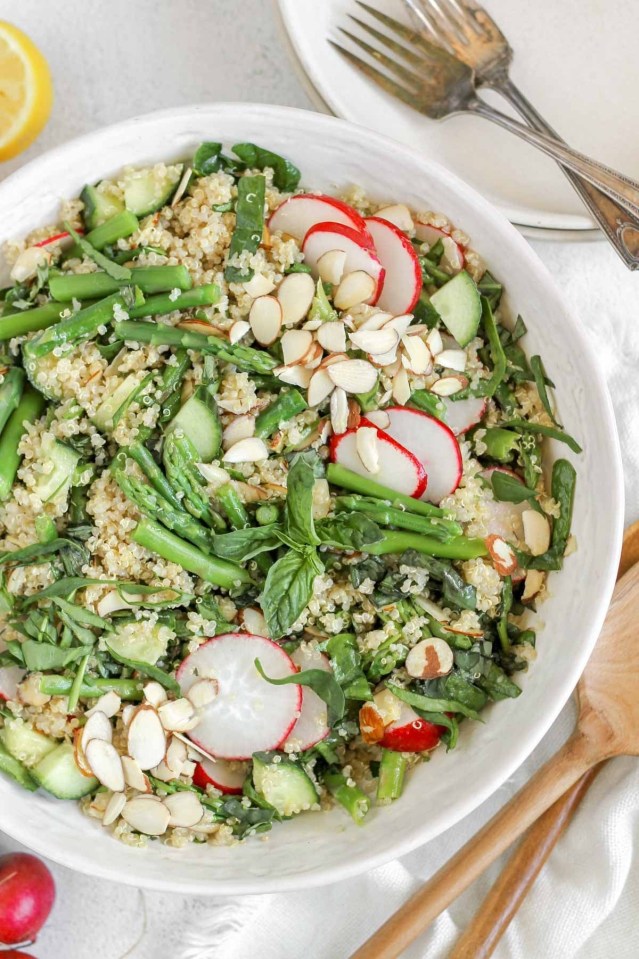
Recipe by Sara Ecklin
Additional details and carbon footprint analysis by Anders Lorenzen
Editorial note:
We are delighted to introduce our collaboration with Sara Ecklin, the founder of Clean Plate Mama. She will bring us a new recipe each month rooted in her passion for clean eating, using locally, organic and sustainable ingredients wherever possible. You can find out more about her and find many more of her recipes on Clean Plate Mama.
Her first recipe for A greener life, a greener world is asparagus quinoa salad. Sara introduces the recipe below.
I’m pretty confident this is the only asparagus quinoa salad recipe you’ll ever need. It’s nutritious, packed with colourful spring veggies and quinoa, all tossed in an easy lemon-honey dressing. This is my go-to seasonal salad, and I love that I can grab all the veggies and fresh basil at my local farmer’s market.
This works for a light lunch, easy dinner or meal prep option for busy weeks. My easy healthy broccoli salad checks all these boxes and is another reader favourite!
Sara’s introduction.
Jump to the recipe
Carbon footprint
This recipe has a very low carbon footprint thanks to its focus on seasonal vegetables, whole grains and plant-based ingredients.
The full recipe has an estimated carbon footprint of approximately 1.35 kg CO₂e, while each of the 10 servings generates around 0.14 kg CO₂e.
That is equivalent to driving roughly 0.8 km (0.5 miles) in an average petrol car per serving, or around 8 km for the entire recipe.
The largest contributor is the olive oil used in the dressing, followed by the quinoa and asparagus. Even so, the overall footprint remains significantly lower than most meals containing meat or dairy.
Carbon footprint by ingredient
| Ingredient | Carbon footprint (kg CO₂e) |
|---|---|
| Quinoa (170g) | 0.17 |
| Asparagus (450g) | 0.23 |
| Radishes (115g) | 0.03 |
| Spinach (60g) | 0.02 |
| Cucumber (120g) | 0.02 |
| Almonds (45g) | 0.10 |
| Basil (10g) | <0.01 |
| Olive oil (120g) | 0.72 |
| Lemon juice and zest (66g) | 0.03 |
| Honey (40g) | 0.02 |
| Dijon mustard (15g) | 0.01 |
| Salt and pepper | <0.01 |
Carbon estimates are indicative and based on UK and European lifecycle assessment data. Actual emissions will vary depending on sourcing methods, transport distances and agricultural practices.
Why you should choose this recipe
- Low-carbon: See carbon footprint section above.
- Supports local small producers and businesses sourced: The majority of the ingredients have the potential to be sourced locally from small independent producers.
- Make-ahead friendly: Prepare the day before.
Recipe: Asparagus quinoa salad
Makes: Approximately 10 side servings
Preparation time: Around 40 minutes
Carbon footprint: 1.35 kg CO₂e
Ingredients:
Salad
- 170g dry quinoa
- 1 bunch 450g asparagus, ends trimmed and cut into 1–2″ pieces
- 115g thinly sliced radishes
- 60g chopped spinach
- 120g chopped cucumber
- 45g sliced almonds
- 5–10 basil leaves, chopped (depending on how much basil you like)
Dressing
- 120g extra-virgin olive oil
- 60g fresh lemon juice
- 1 tbsp. (6g) lemon zest
- 2 tbsp. (40 g) honey
- 1 tbsp. (15g) Dijon mustard
- ½ tsp. (3g) fine sea salt
- ¼ tsp. (.5g) ground pepper
Method
- Cook the quinoa: Follow the package directions and cook the quinoa. After the quinoa has finished cooking, spread it out on a cookie sheet and place it in the freezer to quickly cool. You will want the quinoa cold when you add it to the salad.
- Cook the asparagus: While the quinoa is cooking, prepare the asparagus by blanching it. Bring a medium pot of salted water to a boil and add the cut asparagus pieces. Boil for 1–2 minutes, depending on the thickness of your asparagus spears (see notes).
- Transfer and rest the asparagus: While the asparagus is cooking, set out a bowl of ice water. Once the asparagus is crisp-tender, use tongs or a slotted spoon to transfer it to the ice bath. Once cooled, remove the asparagus and let it dry.
- Combine salad ingredients: In a large serving bowl, combine the cooked and cooled quinoa, asparagus, and remaining salad ingredients.
- Make the dressing: Add all dressing ingredients to a mason jar or other lidded container. Cover and shake until creamy.
- Mix the dressing into the salad: Pour the dressing over the salad and toss until everything is evenly coated. For best flavor, let the salad rest in the fridge for 30 minutes before serving.
- Preservation and storage: Leftovers should be stored in the fridge and will stay fresh for up to 5 days.
Optional add ins
Cheese: Supplement this with either goat cheese, feta or fresh parmesan, with the caveat that you will increase the carbon footprint of the dish
Beans: For a low-carbon and healthy protein boost, you can add a tin of drained chickpeas or oven-roasted garbanzo beans.
Notes & Tips
- Cook the quinoa in advance (even the day before) so it’s cold and ready when you make the salad.
- Thinner asparagus spears will be done in 1–2 minutes, while thicker ones may take 3–4 minutes. Cook until crisp-tender, then remove from the water immediately. Don’t overcook.
Sustainability tips:
- Buy asparagus, radishes, spinach and herbs from local growers or farmers’ markets during the spring season
- Choose organic produce where possible to support more nature-friendly farming practices
- Cook extra quinoa and use it in other meals throughout the week to reduce energy use
- Store leftovers in reusable containers rather than disposable packaging
- Grow basil, spinach and salad leaves at home to further reduce food miles
- If adding protein, chickpeas or other legumes are a lower-carbon option than cheese or meat
Storage, gifting & leftovers
If you keep it refrigerated, it will last for around five days.
Why not enjoy this salad with a glass of homemade elderflower cordial? You can find our sustainable elderflower cordial recipe here. For more seasonal, low-carbon baking inspiration, also explore our low-carbon Christmas sourdough cinnamon scrolls and other sustainable recipes in our growing collection.
Sara Ecklin is the founder of Clean Plate Mama.
Anders Lorenzen is the founding Editor of A greener life, a greener world.
Discover more from A greener life, a greener world
Subscribe to get the latest posts sent to your email.
Categories: food, food and drinks, sustainability, Sustainable recipes
 A greener life, a greener world